Social CRM , building community is the first stage

Social CRM has been gaining lots of attention with whole bunch of new vendors touting their wares as Social CRM products. The concept itself, though is at nascent stage with various interpretations of what Social CRM really means. Definitions also abound from complex, philosophical, to simplistic. Some would tell you that Social CRM is just an extension of traditional CRM with an additional social channel , whereas others would passionately argue that Social CRM is a new paradigm. This is but natural in a evolving and emerging space. Regardless of different views, one thing is certain that emergence of Social CRM is business's acceptance of reality of social customer. A customer who lives in social web, an open , ever expanding network of people. Social web by its viral nature can amplify message or conversation. It is this ability of amplification at very low cost which any brand or marketing manager will find tempting. And the fact that social web is open and accessible , the conversations within it can easily be collected, filtered and converted into insight. And insight about customers is any business's holy grail. Hence It is not a surprise that many businesses looking to implement social CRM are starting with use of listening and sentiment analysis tools.

But real value of Social CRM will not come from listening. The real benefit to a business will come from customer engagement. That is the key difference between traditional CRM and SCRM. Social CRM will not be about attaching an additional channel to operational CRM. It is not that like email or phone, now we get a social channel and have strapped it on CRM system. The reason is that social web, if I may call it, is a different beast. You have to be in it to understand its rules and how it works. The key element of social web is the concept of community and that is where social customer is found. For any business looking to adopt Social CRM, understanding this fact will be crucial. You need to start with the customer, build communities, participate and engage. Community will be the primary vehicle to get insight from your customers, deliver experience and create mutual value. So if you are looking to start with your Social CRM adoption, start with forming communities ; both on your own digital properties and on social web. And this will be the hardest but most important part.

(First posted in Capping IT off, Capgemini's Tech blog)

The Age of Design

In past few years climate and environment concerns have taken centre stage. Though climate debate has many connotations ranging from political to economical it is widely accepted that society has to introspect and change its course in how it produces and consumes. Industrial design will undergo a change. Not only products need to provide " experience" to its users, which anyway is essence of good design, but there will be increased emphasis on how waste is eliminated. For long, designers have overlooked the waste that is produced in process of creating a product or by product. But not in future. So, to paint a happy picture, our houses will get designed akin to a tree which generates its own energy from sun and leaves no trace of waste. Waste has to be eliminated or reduced by design and it is fundamental element of what is being called as Green design. This falls in realm of industrial design, but what about software design! Shouldn’t aim of software design also be to create a compelling experience to its users and eliminate waste?

Charles Eames defines design as "a plan for arranging elements in such a way as best to accomplish a particular purpose". In industrial design, product designers combine skills spanning disciplines of art, science and technology to create tangible goods with focus on aesthetics and usability of end product. In software design, and especially when it comes to design of enterprise software, emphasize is more on how internals of software will be built than how it will be used by end users to achieve their goals. Sample a typical software development process – a need is identified by a department or a group and requirements are captured by business analysts. These requirements are then passed to development team to begin development tasks. The programmers build the application in accordance with style guide that usually dictate elements such as font size, colors, and includes other user interface specifications. In many cases, the application is built with a skeletal interface which is then skinned by a designer to give it required visual appeal as per organization standards . Application is then tested and rolled out to end users. Results could vary from a system which doesn’t meet the real goals of users to frustration emanating from poor usability. This sounds like a sweeping statement in absence of data to back it up but one can safely rely on general perception that enterprise software has. Poor usability causes users to waste time performing routine tasks and lead to a lot of frustration and poor productivity. A definite waste. An aspects which is fundamental to industrial design is visualization. Almost every physical good which is produced is visualized through models before it is actually built. Cars, planes, cell phones all these are visualized during design stage. So a product can actually be "seen" before it is built. In software design, though there has always been practice of prototyping user interface , it is mostly relegated to low fidelity wireframes focusing on information architecture. Except for software built in agile fashion, generally it is too late in day when system becomes "visible" to know what features are really useful and required and what are not. And changes become costlier leading to waste of human effort and money. A definite waste. It is easy to argue that Software design has to encompass broader meaning of designing as a product from user’s point of view and also employ prototyping techniques to visualize before building.

We are in age of design and we see it all around us. These are times of iPods,Web2.0, DIY applications which have hooked users through compelling user experience and have transformed society in their own way. In life that is becoming increasingly busy, where attention spans are decreasing, user behavior is complex, and a marketplace which is dynamic and fickle, organizations that understand essence of design and adopt a user centered approach for software design will do better than those which don’t.

(First posted in Capping IT Off)

What thing is this twitter !

During a recent backpacking trip in Indian hinterland, one of the evenings as I watched TV placed in corner of tea shop in a small town, news of an acrimonious war of words between a famous Indian movie star and a political party was playing on. News channel was reporting what the star had to say on controversy, not through interview given to news agency or channel but through tweets on his twitter account. As the saga was unfolding on twitter the new channel was merely picking it up and broadcasting. Someone seated nearby exclaimed "Ye twitter kya cheej hai (what thing is this twitter)" . And this could have summarized what many people in India have wondered for past few months. Twitter has been in constant news. If it is not a political leader who is fast building a reputation of getting into trouble in parliament because of his tweets ,then it is news about what some Hindi movie star has posted on his/her twitter account. In a way it is ironical that mainstream media that had labeled twitter as flippant when it was gaining traction with geeky crowd and early adopters, is now doing more for twitter's promotion.

Like elsewhere in world, twitter is rapidly growing in India in terms of number of users. Inflection point occurred after tragic Mumbai terror attack when traditional news media discovered how powerful and fast Twitter was in spreading information. For much of last year twitter's growth has been on upswing thanks to quick adoption by news channels and traditional media. There is hardly any news channel now which has not integrated twitter as a feedback and live user commenting tool. But with recent events involving popular movie stars which have brought twitter itself to news headlines and front pages of newspapers, Twitter's growth in India will perhaps go on a different trajectory. Hindi Cinema also sometime referred to as Bollywood is one of two major obsessions in India, other being wildly popular game of Cricket. And with movie stars, coming to Twitter in drove, a different segment of users is taking up to twitter. It is not then perhaps surprising that a news channel recently gave away Indian twitterer of year award to a movie producer and director who it claimed has got large chunk of movie folks and film fraternity onto twitter. Last year, Twitter itself hosted Mallika Sherawat, a Hindi film actress in its office and stated that she was instrumental in membership in India to skyrocket. It is easy to understand why stars and celebrities are adopting twitter as it helps them promote their movies, directly connect to fans and do PR without risk of being misquoted. And of course this is threatening existence of celebrity gossip magazines and paparazzi and is bringing hordes of fans to twitter if just out of curiosity.

It is worth to note that last year in October, Twitter had struck a deal with one of major Indian telecom companies , allowing its users to tweet through SMS on normal rates. It is significant because India has huge penetration of mobile phone users with almost 600 million mobile users as compared to just 50 million internet users. With mobile users projected to grow to 1200 million by 2015, India stands as a lucrative and expanding market for mobile twitter. Twitter CEO ,Evan Williams himself says that even though lots of twitter growth has come through web, their visions has been "to spread Twitter to the weakest connection in the world", which in this part of world happens to be a no frill mobile phone. In a recent TV interview, transcripts of which can be found here, Evans also hints at possible ways of making money through twitter ads as lots of information shared is commercial in nature. He also notes how companies are using twitter to connect to their customers and possibility of making money out of analytics data which companies will be interested in buying. So, as twitter chalks out plans of making money out of its platform, many new users will keep flocking to twitter if only to check ….what thing is this twitter. And as we know, that warrants a long answer.

Some information dynamics for Enterprise IT

While spending some time in an automobile factory recently, where I had chance of meeting many people from production and manufacturing background, I had to frequently explain what I do and since I was amidst many engineers, I found myself calling an information engineer. Not that software engineer is not well understood but It was easier to explain to logistics expert that my job was similar to his. He manages flow of goods and my job deals with flow of information. I know information engineering is just one of approaches we take in software engineering but using this perspective provides a different and interesting view of enterprise IT.

For effective information flow throughout the enterprise, info pipes need be laid down and taps and faucets installed at points where this information needs to be consumed, This can be understood as design of IT system landscape for enterprise and building applications (taps!). Together they can be called Info-structure. The master plan of information flow, the taps that need to be installed and how information will be consumed is what a typical enterprise information architecture would be. It is also required that on regular intervals it is checked that pipes are not clogged and that information is flowing smoothly. Clogged information flow is bad as it blocks and wastes precious human energy. To discover this ,the pertinent questions to ask is if employees have access to information which they need to know to do their jobs better and efficiently. The moment you find employees struggling with and groping for information, you would know that there are problems within organization’s info-structure. And the common symptoms of this are when you hear employees say : "I don’t have this information, I will call Tom", or, " Oh, I know that data is in excel sheet but it is not very recent", or "Let me call Mr. Gupta and check if he has the latest data on this".

In today's fast moving economy where business decision are to be made quickly, the information flow has to become more fluid. For example, in an automotive assembly line, use of SAP for running MRP and production planning is not enough. On demand information is needed, and not just by management but also at lower levels. The buyers department need to know historically which suppliers have problem delivering on time , the store manager need to know how parts age in inventory and if he needs to focus on logistics of certain parts more than the others. Business intelligence or BI is becoming important for this very reason and BI is akin to installing filters over the structured information flow. For information to become more liquid, the data trapped inside applications has to be unlocked and put on gradient. Enterprise also has to become porous as it has to absorb information from outside its boundaries and ,also , if I can put it that way , deliberately leak its own information outside its perimeter including to its customers. Reverse osmosis of information at enterprise boundaries!

Social media is also becoming an important element in enabling info-structure, as these tools are cheap and much effective ways of drawing employees into the information flow or let them plug into info-structure. They become social filters of information and can provide the ad-hoc plumbing over which unstructured information can flow overcoming departmental barriers. Their efficacy in knowledge based enterprises, where production of data or information is primary business is well understood but they are equally important in traditional businesses where information is result of business activities. To provide a simple example, a help manual on chassis number generation or a vehicle parts specification document is ok as a static document exchanged over emails. But, when kept on a Wiki, this information transforms from static to fluid and can flow more easily. And liquidity of information is only one advantage, distillation and refinement is another. Enterprise micro blogging platforms, wikis; they can enable social distillation of information. Increasingly, enterprise IT is going to be lot more about making information liquid and enabling its flow within enterprise and outside it as well. This diffusion of information will create a more "knowing" enterprise and that will be a key advantage in knowledge age.

(First posted on Capping IT Off)

Goodbye to Digital Decade

A day more and first decade of this century will be over. And what a decade it has been, marked with blistering pace of digital revolution which has left everything in sight singed. Such has been impact that decade is being called a digital decade. In span of 10 years we have seen massive changes thanks to advances in digital technology, explosion of internet and unleashing of waves of innovations. Come to think about it, how fast some of application and devices we use today and take for granted have sprung up e.g ; wikipedia: 2001, Myspace: 2003, Facebook: 2004,Youtube: 2005,Twitter: 2006,iPhone 2007,Kindle: 2007 and many more.

In span of 10 years, Google turned from a company to a verb, Facebook became a place to hang out, Youtube redefined blockbusters and Amazon survived dark ages of e-commerce to ride high on clouds. What started as a bug squashing exercise, turned into a dot com boom before crashing with a thud and reviving with everything 2.0 phenomenon. If we risked becoming verbose and blasé with blogger, twitter showed that 140 characters were more than enough to express anything. And this was much after a generation of kids had developed lingos not taught in any language academies, thanks to ubiquitous toy of decade called mobile phone. Oh well, the mobile itself, the question was not whether you had it but how smart it was. Wisdom of crowds, long tail, wikinomics, user generated content threatened some conventional business models and new paradigms emerged. Impact of social networking was not only felt in personal life but inside corporate walls as well, where some old ramparts could be seen crumbling. Low cost of communication and distribution ensured that the word which was with God was finally and truly appropriated by men.


In an old Indian philosophical thought, evolution, is seen as a progressive manifestation of nature ( to experience itself). Evolution doesn’t always result in what can be called a happy path scenario and in those circumstances self-correction is done. In similar vein, we can see human intelligence virtually exploding in many forms in this digital decade and moving towards some kind of distant Omega Point. The pace of this technology innovation has been so rapid that its impact on society's fabric and different aspects like political, legal and social is yet to be known fully. May be we are going to discover that not all innovations and technology made our life easier or fruitful after all. Now we have less time to do more things. Growth has become a monster which has to be constantly fed. "What Next!" drives us and there is almost sense of paranoia if we can’t see that Next. To some , digital technology and specially the Internet has ushered in a cult of the amateur that is "taking us back into the Dark Ages". Change always creates flux and that unsettles many. Regardless of different views, one thing is certain, that the mark has been made. Future generations will look back at this decade and perhaps wonder how it would have been to live through those years when epochal changes were taking place. Or possibly they are going to look back and wonder about a decade of digital stone age. Time will tell, as someone has said, future is not googlable.

(First appeared on Capping IT Off )

Does Agile mean no Processes and no Governance?

There are two generally held perceptions about agile. One, that agile is a kind of anarchist model with no processes, and second, that agile means no governance. Let’s look at the first perception that agile means no processes. We can understand how agile looks at need of processes by applying a well known principle called Occam's razor which states that ” one should not increase, beyond what is necessary, the number of entities required to explain anything”. The principle helps us to remove those concepts, variables or constructs that are not needed to explain a phenomenon. By doing this, it becomes easier to create a model which resembles reality much better and redundancy and inconsistency is removed. In essence, Occam's razor stipulates that when multiple theories are available to explain a problem, the simplest one is preferred. Nature likes simplicity. Ocaam's razor when applied to project management methods would imply that a Project should have only those processes which are required and not more. This is exactly what agile paradigm means with its use of low ceremony, just enough processes. Agile teams chose processes which are most relevant for them to meet their goals in their context. It means you do not pick set of pre-defined, rigid processes in a bunch and deploy them on a project. A process is good as long as it adds value to project; or it should be discarded or amended. So, why is to so hard to agree with this!

It is possibly due to the fact that traditional management methods have relied heavily on process standardization and execution efficiency. But it has not helped achieve predictability of results which is clear from number of IT project failures. Today's business scenario is vastly different with constant change and dynamic markets. Project teams like Organizations need to adapt quickly. Traditional methods, which are based on "execution as efficiency”, find this hard to achieve because they inherently oppose changes in system. In a Harvard business review paper published in 2008, Professor Amy Edmondson identifies a different approach to execution, called "execution as learning" which looks uncannily similar to agile thinking of software development. She calls execution as learning “a radically different organizational mind-set, one that focuses not so much on making sure a process is carried out as on helping it evolve". Agile practitioners would easily relate to her thoughts and “execution as learning” looks very similar to agile manifesto.

Second perception about agile is that there is no or very little Governance in agile methods. But the fact is that agile makes governance more effective as it puts onus on participation of all stakeholders in project. Traditional command and control governance models usually end up creating bureaucratic hurdles and illusion of control. Agile governance model on the other hand is about enabling the team and facilitating an environment where team can meet its objective without avoidable hindrances. Whole team principle is about shared vision and goals and that there are no finger pointing and putting the blame when and if things go wrong. Should project sponsor remain a distant illusive figure or rather become part of the team! Perception of agile being low on governance perhaps comes from principle of "self-organizing teams". Scott Ambler explains this principle when he says that "self organizing doesn’t mean that you are out of control and doing your own thing. It means that team members are themselves deciding how to meet the goals. But the goals they have to meet, the resources used and timeframe, are governed by organization". Agile governance he says is about keeping the baby and throwing the bathwater. And that might well summarize processes and governance perspective in agile.

(First appeared on Capgemini technology blog )

Capgemini's first ever Barcamp

It has been exciting time for past couple of days in preparations for Capgemini India's (and perhaps Capgemini's) first ever Barcamp which is happening tomorrow, 11th September in Mumbai. In fact we already have a Barcamp being run in Capgemini Bangalore today as part of this synchronised Capgemini India Barcamps. We had many people volunteering with tasks like creating logos, stickers, banners to coordinating with internal sponsors. The internal wiki was used for registration. We put up huge Barcamp banners in office with some fantastic posters created by Tarun. We weren't sure of how much participation we would get and were surprised to have more than 100 registrations. Not a Bad start.

Because of logistics and few other reasons the event is being attended by Capgemini employees only , so many people could comment that it is not a true, pure barcamp. But then purists are purists. They have a role to play. Our aim is to introduce unconferences and barcamps as an alternate method of learning within the company and also spread idea of barcamp among many people who are not exposed to it. I am sure we will soon have versions of Capgemini Barcamp running in thier pure form with wider and external participation.

For now, I hope this Barcamp would clear few mindblocks and give few people another perspective of learning and sharing in open, informal and collaborative enviornment....

Problem with Enterprise Search- new veriosn of GSA launched

Google has launched new version of GSA (Google Search Appliance) meant for deployment within the firewall to do enterprise searches. There are some improvements built inside yellow box which is how standard GSA is shipped. Google claims that GSA can now index many million more pages, can conduct searches faster than ever and show role based search results. So for so good. The problem is that enterprise search is not about searching millions of pages or spitting query results a bit faster. The problem is that enterprise search engines don't work. The real problem is that it is not easy to find anything relevant. And the problem is not with search engine like GSA. The real problem is in very nature of enterprise and its content management and intranet systems.

I have worked a bit with GSA sometime back. It is extremely easy to install and use. Mostly, you point it to sites and sources you want to index, trigger its crawler, let it build its index and there you start searching with familiar Google UI, all out of box. Google has spent a decade perfecting search algorithms. It uses complex rules to bubble up the most relevant results for a user query on top of result pages. Page rank or relevancy of a page is calculated based on how page is cited by other pages, their interlinking and metadata which crawlers extracts from page elements like title, header and other structural elements (typical SEO domain). And it works so well on web because web has huge scale. Web is huge mass of interlinking web pages where cross referencing through links is a norm. This Interlinking of pages is most important factor for determining relevancy of result pages for a query.

When I say that enterprise search doesn’t work, what I mean is that results which search engines throw are hardly relevant. Unlike on web search where first few results are almost always most relevant to a query, in enterprise search, it is hardly true. You can get results which are no where relevant to your query and most important and relevant documents might be buried somewhere in huge pile of results, where you would never reach. The reason is simple, that enterprise systems and intranets don’t use cross-linking of pages and sources. There no almost non existent cross references. For example how many times would you find a "Banking Industry opportunity PoV" document or page cross referencing to another document which could be "Banking Industry Trend Analysis"!! In fact, many enterprise systems are like document storage systems where all the documents in form of excels, ppts, pdfs are dumped as equal. Search engine has no way to find which most relevant document for a query is. On top of that, most enterprise systems and intranets are not optimized for search engines. How many times, have you seen web pages on intranet which have no title or use proper Meta data!! The content creators don’t use some basic practices to make their content “findable”. So another vital source for search engine to determine page relevancy is lost. And what we get in effect is a sputtering and struggling search engine trying hard to fish out that most important document for you.

In a way, it is not problem with technology but with very nature and realities of enterprise. IMHO, an effective intranet search engine has to provide more than "out-of- box" features; it should be "tweak-able". It has to work with understanding that:

  1. Enterprise content is not cross linked and cross referenced, so relevancy logic successful on web wouldn't be much useful.
  2. Scale of content is limited, unlike web where million of pages are cross-linking, enterprise content is not so vast.
  3. Pages are not optimized for search engines. (But that should be fixed by a company's policy)
  4. Some documents written by some "experts" or “communities” in enterprise become naturally more important or relevant! The relevancy logic has to account for that, but how! Engine administrators should be able to feed new relevancy rules into the engine.
  5. User ratings of documents and META -TAGS on web pages should be given more weightage in calculating relevancy. On web, these are mostly ignored due to their misuse for search engine spamming, but this is not the case in enterprise where problem is opposite.


From another perspective, a human edited search engine could be more useful and effective within firewall. Automated search engine can still be used to find out what are users searching most of time (trends), and experts, knowledge managers or users can contribute to index and ranking of pages manually. New version of GSA also seems to have a similar feature for Do It Yourself (DIY) key-match and some features for administrators to influence search results.

Prayer for K2 Climbers

Ever since I have been on trek to ABC in Nepalese Himalayas, I have become fascinated with mountain climbing. It is perhaps toughest challenge any man can go through, both physically and mentally. Those tall irreverent himalyan mountains allow only the fittest and strongest of men to climb them and I have nothing but respect for men who indulge in this dangerous activity. Mountain climbing community is very small and plugging to it gives a different perspective on life. It is a different world altogether. Ever Since I read Maurice Herzog's classic book Annapurna detailing Frenchman's first and successful ascent of a 8000 meter peek, I have peeked into fascinating world of Louis Lachenal, Lionel Terray, Gaston Rebuffat and many such legendry climbers. The community has its own hierarchy with toughest, high altitude climbers on top. There were climbers like Anatoli Boukreev, who was daredevil to the extent of being mad, climbing without acclimatization or without oxygen. He was also climbing during 1996's Everest tragedy when 8 climbers were killed in one day. The expedition created lots of controversy with Jon kraukauer , a journalist and climber partly blaming Boukreev for not saving some of climbers trapped in snow storm. An Indian climber who died on same tragic day on Everest, was still lying dead just beneath the peak until recently. For almost 10 years his dead body was used by climbers as a milestone (called greenboots) on way to Summit. In recent times, many controversies and debates have arisen where some people within community have decried the attitude of climbers to reach the summit at any cost and not helping or rescuing other climbers who might be in distress. In 2006, David Sharp, a British Climber laid dying on the way to Everest peak, even while 40 other climbers passed him without offering any help or rescue. There is someting in us, men, which is tested only when faced with extreme adversity like in case of Joe Simpson and Simon Yates's disasterous climb on a Peruvian mountain so brilliantly captured in book and movie Touching the Void.


Even though men would often in their follies term their successful climbs and summits as conquests, these mountains invariably keep reminding them who the real lord is .Freak weather, falling stones, sudden avalanches, extreme weather, anything can kill even most experienced and trained climber as happened on K2 yesterday. In deadliest day in K2's history ,11 climbers reportedly died while scaling K2. K2 is said to be the most difficult of mountains to climb with its razor sharp ridges and unpredictable weather. The deadly mountain is also said to be cursed for women as only 5 women could reach the top, 3 of them died on decent and rest 2 died later on other mountains. Regardless of obvious danger, K2 keeps attracting climbers like bees to the flame. It is said to be a handsome and mighty mountain which is also equally unforgiving. Here is little silent prayer for those who died scaling it yesterday.

About Me


Some questions used to have simple answers......(roll mouse over picture)

Fixed Price projects - Inconvenient truths by Scot Ambler

\A Fixed price project\


In recent times, for some reason, call it bad karma perhaps, I have been part of projects which have had contractual and cost issues. Projects followed BRUF (Big Requirements Up Front) method to accumulate requirements, estimates and pricing were done and contract signed with Customer. The fixed price project was started. And the problems which ensued were typical of so many such projects in industry. They are well documented variousuly, so I am not going to add to that. But I have often wondered why customers insist on agreeing to a fixed price in beginning of a big project when most of times scope can hardly be known. What it does is that, it makes both the parties, the customer and the IT Supplier draw the lines like in a battle and start on a war footing with Sr. Management on both the sides acting like Generals engaged in high strategy. Supplier implements strict change control procedures and become fixated by change management and repelling anything not in original scope. As initial estimates done during contract signing phase can't be relied upon for accuracy, big contingencies are built into estimates but without any surety of its finality. Customer in meanwhile practicaly disengages during project execution waiting for the final delivery to happen as most of his risks are offloaded to supplier. The whole dynamics of a fixed price project creates an enviornment where both the customer and vendor are playing games to protect themselves and not working together to solve the problem for which project is being executed.

Scot Ambler in this articles has articulated what he calls Inconvenient truths about fixed price software development. In fact he goes even further and calls it an unethical practice. Most of points he has highlighted are valid and right on target. Customers have to realise that if they really care about ROI, they need to engage and work with suppliers and not look to offload thier risks in form of fixed price projects. IT vendors or providers on other hand , have to relook into thier own practices which they have been selling to customer for years . As Scot Ambler says "For several decades traditional software engineering theory has told us to do formal, up-front cost estimates. In turn, we have taught our customers that this is the way things are done " . So it is time we teach them that we were wrong.

cuil a google killer

\Cuil.com to beat google\

Twitter was on fire yesterday after cuil.com a new search engine was launched after much hype on techcrunch. Everybody seems to be waiting for google killer, maybe scared of its monopoly. Only if it was as easy as that. Google can't be beaten by mere hype and PR. Cuil claims that "...we searches more pages on the Web than anyone else—three times as many as Google and ten times as many as Microsoft." Really!! But I can't find my blog through it, it returns 0 records. what is the deal about this large index!!

Wiki adoption in enterprise - Participation inequality

There have been few online discussions about how emails and word documents are bad and their use in collaborative environments and organisations should be reduced. I mostly agree. Email within enterprise has become most used tool and often work comes to standstill if email is down. So regimented have we become with use of emails that we don’t want to use tools which are far better suited for today's changing times of increased collaboration where participants are often sitting across continents. Email is a great tool but like any other tool it is meant to do a certain task and not everything. While championing the use of wiki for team collaboration, I had few observations:

  1. No learning new tool: Many people don’t use wikis because they don’t want to learn a new tool. Even though using wiki is as simple as typing in plain English with some simple mark up, it appears too much to learn for many.
  2. Old Habits Difficult to Change: Many just don’t get it why they should not use MS Excel and MS word for certain tasks and instead should be asked to use the wiki. They think the wiki is an overhead and they dont have time to go to a site and put content there. They dont consider wiki as a tool but as some fancy site. Old habits die hard.
  3. Email Regimentation: Heavy use of email has regimented us. I have seen many people doing their wiki contributions starting with "hellos" and ending with "regards" like they do in emails.
  4. Scarcity is power: Many feel threatened by wiki culture as it takes away the control. Information and knowledge is the power. Scarcity of information is what makes certain people derive their power and authority. They wouldn't want to let it go. They want to keep the information scarce.
  5. Openness is scary: Wikis are open and content can be created/edited and deleted by user. That scares lots of people. Many years of corporate life where every tool is controlled and every usage need some sort of approval by someone, this openness and control sounds too good and too scary.
  6. No incentive to contribute: Wiki pages are result of collaboration and author names are not displayed on top of page. This puts off people as they are used to announce their names on top of word documents. Word documents can be sent over emails with CC to all those people who would do your year end performance reviews. Personal efforts are recognised and not the collaborative so there is little incentive in contributing to wiki.
  7. Volunteering is unfamiliar: Wikis are flat, unstructured and non-hierarchical. That is exactly opposite of what an enterprise is. People who are too accustomed to hierarchies and being directed, volunteering to wiki remains an unfamiliar territory.

All This though is hardly surprising as most of multi-users communities suffer from this pattern of behaviour where very few people contribute and most just lurk around. This is also called as participation inequality and is excellently explained by Jacob Nielsen. As per this theory :

In most online communities, 90% of users are lurkers who never contribute, 9% of users contribute a little, and 1% of users account for almost all the action

The benefits which a simple, social and collaboration tool like wiki can bring behind firewall are immense but there remain few roadblocks to overcome to make wikis a success. I stumbled upon a site called wikipatterns , which does a very nice job of documenting patterns on wiki adoption. It s many patterns some of which I have personally come across, like wiki phobia (somewhat similar to my point 4 above). Reading the patterns, I just realised that I was about to become a Wiki Bully.


Enterprise2.0 - Let conversations happen

Transformation into Enterprise2.0 has to begin with enabling social software. Let employees connect, network , share and have conversations :) You got to know the change agents, the idea generators, the transmistors. The long tail of enterprise.


\Enterprise2.0\

Twitter Addiction

What Twitter is doing to Normal people.

\Twitter Addict\

Evolution of Web from 1.0 to 3.0


Journey from ....web1.0 ...........to web2.0..............to web3.0...

Enterprise 2.0 (Part 2) - Use Web Standards to unlock data

In my previous post on Enterprise 2.0 , I wrote about adopting people centric/social focus of web2.0 within company intranet and build corporate facebook as central piece of intranet. One of other aspects of web2.0 is use and adoption of web standards and creation of rich UIs. Web2.0 has put emphasis on making web systems standard compliant, something which was done but not with same zeal in Web 1.0 world. Some of standards and technologies which we find in web2.0 systems are:
  • XHTML (transitional and strict)
  • CSS 2.0
  • JavaScript (AJAX style)
  • Microformats
  • Clear and sensible URIs
  • REST style of architecture

I remember that until few years back, many developers I knew, use to shy away from working on HTML/JS/CSS , treating them like low grade vassals. Coding backend was always considered sexier proposition. Web2.0 thankfully has brought focus back on these simple but powerful technologies. Proper delivery of content and creating rich and responsive UIs is as complex and important a task as it is to code backend to support business logic. Anybody working in an organization would tell us what kind of "shitty" applications they have to deal with everyday. And reason for this is that almost no effort was spent on “designing usability” of those applications. I have seen applications where users have to navigate 4 screens just to choose a value for a text field. Usability aside, there has generally been an ignorance about adopting web standards while building web applications behind firewall.

The reason that web standards should be adopted and enforced is for simple reason that standard compliance makes it easier to integrate applications and at same time reduce the barriers to access the data. As I wrote on one of my previous posts, properly designed URI space can be so helpful in unlocking the information and making it easier to access and reuse. Use of validated XHTML for building UIs is that semantic is built right in the web page and another application can parse it and do something useful with it when needed. Microformats are another simple but powerful format for encoding the data. Many organizations struggle with multiple sources and formats of employee profiles and resumes scattered all across variety of systems. There could be few online profiles, directory entries, PPT profiles (trust me) or employee bio-data kept in a word file and stored in file storage. This all could be simplified by adopting “hRes like Microformat” to encode employee resume making it human readable and machine parsable at same time. Any other system which might need word format or pdf format of resume, can just parse the microformat based resume (passed as an URI :)) and emit it in a word format. This is only a simple example but goes on to show how using web standards makes data and information more mobile and Integrate-able and you don’t always need heavy duty SOA to make that happen for you.

In essence, organization IT has to have guidelines and principles which should dictates that all internal web systems follow web standards and these guidelines should be know to all those who manage and build web systems within organization. Adoption of these simple standards would result in value creation resulting from unlocking of the information which otherwise get entrapped, becomes static and get stuck in silos of application landscape.

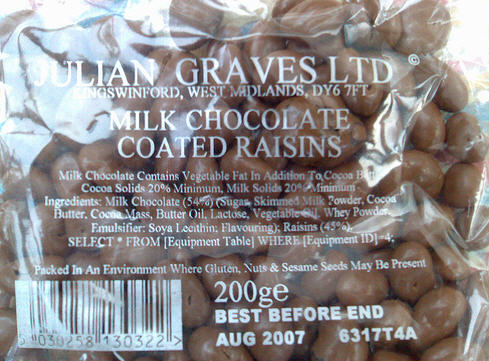
SQL flavoured Chocolate.

TheDailyWTF (What The Fu**) is so hillarious, Just came across this funny piece. full article here, try finding out an SQL statment on a chocolate wrapper below: